Scintillation: the process of emitting flashes of light.
“SCINTILLATIONS” is a freeform mallet quartet in two parts which may be played in succession or independently. Suggested instrumentations are 4 marimbas or 2 vibraphones + 2 marimbas, although “SCINTILLATIONS” may be performed on any percussive (or non-percussive) instruments.
“SCINTILLATIONS” was premiered by the Vanderbilt Percussion Group at the Blair School of Music on April 4th, 2018. Clark Hubbard was asked to arrange the piece for non-melodic percussion instruments, and a drums-only version of this piece was premiered by the Eschaton New Music Ensemble on April 25th, 2018. Both (pitched + un-pitched) versions of “SCINTILLATIONS” are included in the score.
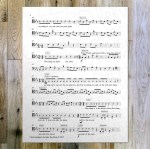
PART I This movement draws inspiration from Peter Garland’s mallet quartet “Apple Blossom.” “SCINTILLATIONS, PART I” is a lush chorale where the chords slowly dissolve into one another. The score is a diagram with the progression of notes indicated spacially [shown below]. The duration of this movement is indicated 6-15 minutes, although the length is ultimately left up to the ensemble.
Notes should be sustained (via rolls, bows, etc) throughout the movement and may also be sustained through the opening of “PART II.” “SCINTILLATIONS, PART 1” should begin at a pianissimo dynamic, but the performers should feel free to swell and grow as they see fit. The indicated pitches may be performed in any octave on the instrument, although treble and bass clef symbols are presented to suggest a general range.
PART II This movement is similar in spirit to “PART I,” but now includes a rhythmic variable. Each performer is presented with a series of cells/measures that include a set of pitches and a specified “number of attacks.” Each cell may be repeated an infinite number of times, but the entire ensemble should progress to the next cell in unison.
PART II • Rhythmic Notation Each cell should be approximately 3 seconds in length (alternatively, each cell can be interpreted as the duration of a single quarter note at 20bpm). Above each cell, a specific number of attacks are indicated. Performers may play the number of attacks per cell in any rhythm they desire (ex. if a cell indicates “3 Attacks”, the performer may play a triplet, two 16th notes followed by an eighth note, a dotted eighth note followed by two 32nd notes, etc). The cells may be repeated infinitely and each performer may have a slightly different interpretation of the length of each cell. The performers do not need to play each cell in rhythmic unison but should progress to the next cell at approximately the same time. PART II • Harmonic Notation Each cell indicates a single pitch or a series of pitches. Like “PART I,” these may be performed in any register, although a general guide of treble and bass clef is presented. Performers should map the rhythmic component of each cell onto any of the indicated pitches. Performers should avoid double stops, playing only one pitch per attack.
“SCINTILLATIONS” is great for students who want to explore percussion music with unconventional notation and for students looking for a piece that offers communicative + interpretive challenges rather than technical challenges.
*in the linked audio recording, “Part II” of “SCINTILLATIONS” was performed using an earlier edition of the score. In that edition, the rhythms were more rigid and defined. In the current edition, the rhythmic structures are dramatically more free and unpredictable.
“Outside The Pane” is a piece I wrote for Aislinn Bailie in 2017. The piece was premiered on October 10th, 2017 by Aislinn Bailie at Vanderbilt University’s Blair School of Music. “Outside The Pane” is a challenging piece requiring the performer to quickly alternate between playing bassoon and speak/singing throughout the piece. When writing this piece, I was trying to capture the sounds of a contemporary pop song while being limited to a single line of music. This resulted in the arpeggiated bassoon lines and the struggle of the performer covering both vocal and accompaniment duties. In addition to the struggle of alternating between playing and singing, the text provides additional challenges as it heavily features stuttered syllables and homophonic wordplay. I composed the text for this piece at the same time I composed the music. “Outside The Pane” is a re-telling of the story of Noah’s Ark from the Book of Genesis in the Bible. Instead of focusing on Noah, his family, and the animals he has saved on the ark, this re-telling turns the focus towards Noah looking out of the ark, watching the destruction of the world around him.
Thank you to Aislinn Bailie for letting me experiment with bassoon music, helping me flesh out the narrative of this piece, and for being awesome in general!
ru- ru- running down as the falling falling rain rain falling rain falling rain rain falling fall. out.going to see outside the out out going to see outside the pane flaying down as flying down is hard looking to see outside the pain paneflooding the land, my landseeing out I cannot be seeing it’s a sea I’m looking outside of the window pane flooding it is flooding it flow flooding how do I stop outside the panecold is the water outside the water outside of the panelook into my eyes and see my eyes look into my eyes and the seaoutside of the pain pane outside of the outside of the panelooking looking down on the falling looking on the outside of the pane looking on the outside of the pain outside of the pain pane outside of the pane



 Clark Hubbard | Music
You must be logged in to post a comment.