(dedicated to Rashaad Greene, written for GreeneShark Duo)
About “Skywire”
While “SKYWIRE” is a percussion duo scored for drum kit + vibraphone, it can also be interpreted as a multi-percussion duo where one setup consists of instruments found in a drum kit and the other setup consists of keys on a vibraphone. Although the vibraphone is treated as a multi-percussion instrument, there is still a clear melodic shape throughout the piece.
The drum kit + vibraphone exchange melodic and rhythmic while each percussionist has the opportunity to function as the lead voice and accompaniment.
The drum kit part calls for the percussionist to perform grooves that utilize the entire drum kit as well as improvise. The vibraphone part calls for the percussionist to play with four-mallets and switch between playing on the center/edges of keys and the nodes to produce various colors and timbres.
“SKYWIRE” is great for students looking for a percussion duo that are interested in drum kit, vibraphone, or multi-percussion music with a jazz/pop influence. “SKYWIRE” features melodic playing, intricate polyrhythms, colorful textures, and a balance between loose/improvisatory moments and fast-paced passages.
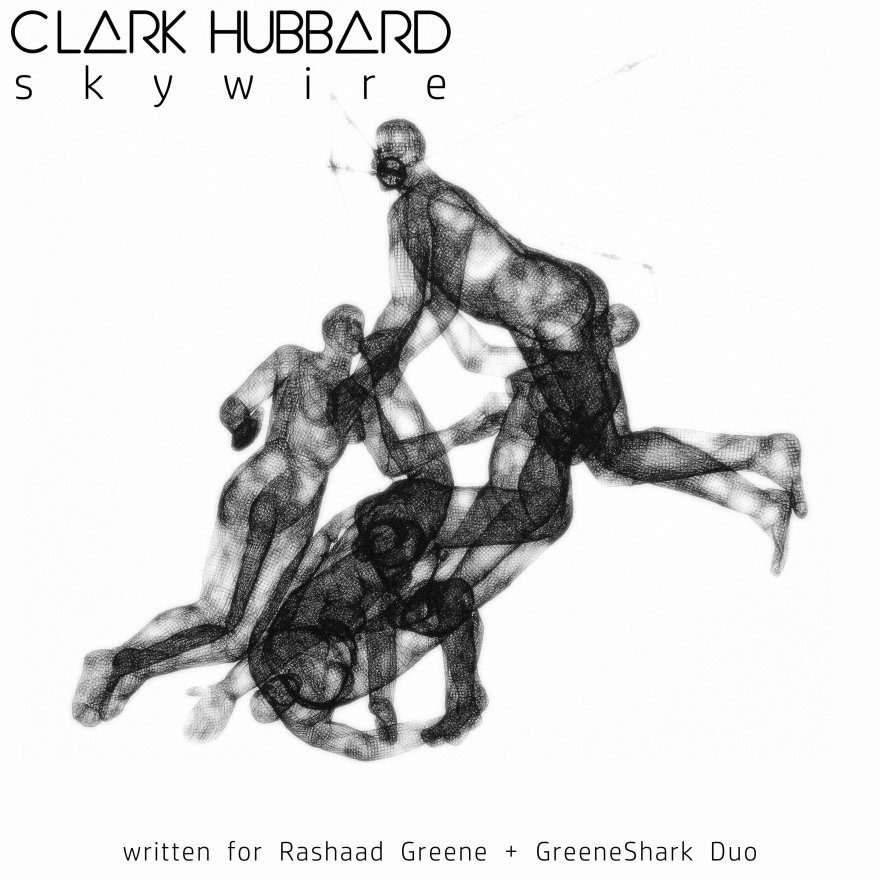
The image on the cover of this piece is of a sculpture hanging above the streets outside of the Astrup Fearnley Museum of Modern Art in Oslo, Norway.
Scintillation: the process of emitting flashes of light.
“SCINTILLATIONS” is a freeform mallet quartet in two parts which may be played in succession or independently. Suggested instrumentations are 4 marimbas or 2 vibraphones + 2 marimbas, although “SCINTILLATIONS” may be performed on any percussive (or non-percussive) instruments.
“SCINTILLATIONS” was premiered by the Vanderbilt Percussion Group at the Blair School of Music on April 4th, 2018. Clark Hubbard was asked to arrange the piece for non-melodic percussion instruments, and a drums-only version of this piece was premiered by the Eschaton New Music Ensemble on April 25th, 2018. Both (pitched + un-pitched) versions of “SCINTILLATIONS” are included in the score.
PART I This movement draws inspiration from Peter Garland’s mallet quartet “Apple Blossom.” “SCINTILLATIONS, PART I” is a lush chorale where the chords slowly dissolve into one another. The score is a diagram with the progression of notes indicated spacially [shown below]. The duration of this movement is indicated 6-15 minutes, although the length is ultimately left up to the ensemble.
Notes should be sustained (via rolls, bows, etc) throughout the movement and may also be sustained through the opening of “PART II.” “SCINTILLATIONS, PART 1” should begin at a pianissimo dynamic, but the performers should feel free to swell and grow as they see fit. The indicated pitches may be performed in any octave on the instrument, although treble and bass clef symbols are presented to suggest a general range.
PART II This movement is similar in spirit to “PART I,” but now includes a rhythmic variable. Each performer is presented with a series of cells/measures that include a set of pitches and a specified “number of attacks.” Each cell may be repeated an infinite number of times, but the entire ensemble should progress to the next cell in unison.
PART II • Rhythmic Notation Each cell should be approximately 3 seconds in length (alternatively, each cell can be interpreted as the duration of a single quarter note at 20bpm). Above each cell, a specific number of attacks are indicated. Performers may play the number of attacks per cell in any rhythm they desire (ex. if a cell indicates “3 Attacks”, the performer may play a triplet, two 16th notes followed by an eighth note, a dotted eighth note followed by two 32nd notes, etc). The cells may be repeated infinitely and each performer may have a slightly different interpretation of the length of each cell. The performers do not need to play each cell in rhythmic unison but should progress to the next cell at approximately the same time. PART II • Harmonic Notation Each cell indicates a single pitch or a series of pitches. Like “PART I,” these may be performed in any register, although a general guide of treble and bass clef is presented. Performers should map the rhythmic component of each cell onto any of the indicated pitches. Performers should avoid double stops, playing only one pitch per attack.
“SCINTILLATIONS” is great for students who want to explore percussion music with unconventional notation and for students looking for a piece that offers communicative + interpretive challenges rather than technical challenges.
*in the linked audio recording, “Part II” of “SCINTILLATIONS” was performed using an earlier edition of the score. In that edition, the rhythms were more rigid and defined. In the current edition, the rhythmic structures are dramatically more free and unpredictable.



 Clark Hubbard | Music
You must be logged in to post a comment.