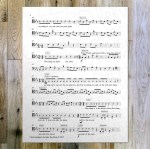
Outside The Pane

Duration: 3:32

Difficulty: ★★★★☆

Released: 2017

Players: (1) bassoon + voice

Purchase PDF Sheet Music

(written for Aislinn Bailie)

About “Outside The Pane”

“Outside The Pane” is a piece I wrote for Aislinn Bailie in 2017.
The piece was premiered on October 10th, 2017 by Aislinn Bailie at Vanderbilt University’s Blair School of Music.   “Outside The Pane” is a challenging piece requiring the performer to quickly alternate between playing bassoon and speak/singing throughout the piece. When writing this piece, I was trying to capture the sounds of a contemporary pop song while being limited to a single line of music. This resulted in the arpeggiated bassoon lines and the struggle of the performer covering both vocal and accompaniment duties. In addition to the struggle of alternating between playing and singing, the text provides additional challenges as it heavily features stuttered syllables and homophonic wordplay.   I composed the text for this piece at the same time I composed the music. “Outside The Pane” is a re-telling of the story of Noah’s Ark from the Book of Genesis in the Bible. Instead of focusing on Noah, his family, and the animals he has saved on the ark, this re-telling turns the focus towards Noah looking out of the ark, watching the destruction of the world around him.

Thank you to Aislinn Bailie for letting me experiment with bassoon music, helping me flesh out the narrative of this piece, and for being awesome in general!

ru- ru- running down as the falling
falling rain rain falling rain falling
rain rain falling fall. out.going to see outside the out out
going to see outside the pane
flaying down as flying down is hard
looking to see outside the pain paneflooding the land, my landseeing out I cannot be seeing it’s a sea
I’m looking outside of the window pane
flooding it is flooding it flow flooding
how do I stop outside the panecold is the water
outside the water
outside of the panelook into my eyes and see my eyes
look into my eyes and the seaoutside of the pain pane
outside of the outside of the panelooking looking down on the falling
looking on the outside of the pane
looking on the outside of the pain
outside of the pain pane
outside of the pane

Kitchen Music, Part I

Duration: 4:00 (approx.)

Difficulty: ★★★☆☆

Released: 2017

Players: (1) 10 found objects + microwave

Purchase PDF Sheet Music

About Kitchen Music

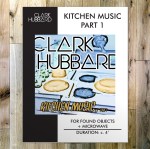
“KITCHEN MUSIC” is an indeterminate piece I wrote to experiment with music notation. I wrote this piece to be played in the kitchen my dorm room at Vanderbilt University (the original setup is pictured in the cover art) hence the name “KITCHEN MUSIC.” This piece can be played in the kitchen or the concert hall.

“KITCHEN MUSIC, PART 1” is great for students interested in multi-percussion music, unconventional notation, improvisation, or with limited access to traditional percussion instruments.

How To Read This Score

For this piece, the score is comprised of three lines of rhythms, and a grid.

  • Along the left side of the grid are the list of instruments: 4 tuned glasses (any pitches), 2 bowls, 2 plates, and 2 other found sounds (originally I found two parts of an oven to play on). The other instrument needed to perform this piece is a microwave.
  • Along the bottom of the grid are measure numbers. Each column is a measure.
  • Along the top of the grid are rhythmic numbers. These numbers correspond to the three lines of rhythms written above the grid.

The score (grid) reads left-to-right. The performer can repeat each measure as many times as they want. Shaded squares indicate the instruments that can be used during that measure. The performer should use all of the instruments indicated in each measure to play the given rhythmic structure. For example – in measure 5, the performer should play rhythm #2 on tuned glasses 1 & 4.

You will notice that in measure one, the indicated rhythm is “W” and in measure fourteen the rhythm is “M.”

  • “W” – Fill Bowl 2 with water and strike Bowl 2 with mallet/stick one time.
  • “M” – Place Bowl 2 in microwave and set it to cook for 30 seconds.

The lines and dots around measures 15 & 16 are meant to indicate that these measures are to be repeated while the water is begin cooked in the microwave.

Performance Notes

Select a microwave that has a repetitive (and potentially annoying) dinging sound when the microwave’s timer goes off. The piece ends with the performer playing rhythm #2 against the rhythm of the microwave’s timer.

To end the piece, it is up to the performer whether or not they will turn off the microwave’s timer at the same time they stop playing, before they stop, or after they stop.

At the beginning of the piece, the performer must fill Bowl 2 with water. In the original setting for this piece, the performer could simply turn to the sink and fill up the bowl (since this piece takes place in a kitchen). To perform this piece in a concert hall, feel free to use other means to fill up the bowl (water bottle, bucket, hose, etc).

At The Dock

Duration: 3:38

Difficulty: ★★★☆☆

Released: 2016

Players: (1) piano

Purchase PDF Sheet Music

About “At The Dock”

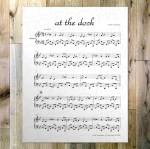
“At The Dock” is a folksy movement that plays with the relationships of melody and accompaniment. The themes in the right and left hands are slightly different lengths giving the piece its unique character. As each theme is repeated, they each become further and further displaced until they line up and begin the displacement process all over again.