

Duration: 4:00 (approx.)
Difficulty: ★★★☆☆
Released: 2017
Players: (1) 10 found objects + microwave
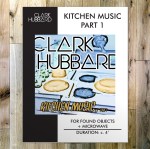

About Kitchen Music
“KITCHEN MUSIC” is an indeterminate piece I wrote to experiment with music notation. I wrote this piece to be played in the kitchen my dorm room at Vanderbilt University (the original setup is pictured in the cover art) hence the name “KITCHEN MUSIC.” This piece can be played in the kitchen or the concert hall.
“KITCHEN MUSIC, PART 1” is great for students interested in multi-percussion music, unconventional notation, improvisation, or with limited access to traditional percussion instruments.
How To Read This Score
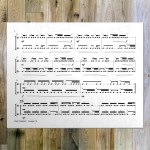
For this piece, the score is comprised of three lines of rhythms, and a grid.
- Along the left side of the grid are the list of instruments: 4 tuned glasses (any pitches), 2 bowls, 2 plates, and 2 other found sounds (originally I found two parts of an oven to play on). The other instrument needed to perform this piece is a microwave.
- Along the bottom of the grid are measure numbers. Each column is a measure.
- Along the top of the grid are rhythmic numbers. These numbers correspond to the three lines of rhythms written above the grid.
The score (grid) reads left-to-right. The performer can repeat each measure as many times as they want. Shaded squares indicate the instruments that can be used during that measure. The performer should use all of the instruments indicated in each measure to play the given rhythmic structure. For example – in measure 5, the performer should play rhythm #2 on tuned glasses 1 & 4.
You will notice that in measure one, the indicated rhythm is “W” and in measure fourteen the rhythm is “M.”
- “W” – Fill Bowl 2 with water and strike Bowl 2 with mallet/stick one time.
- “M” – Place Bowl 2 in microwave and set it to cook for 30 seconds.
The lines and dots around measures 15 & 16 are meant to indicate that these measures are to be repeated while the water is begin cooked in the microwave.
Performance Notes
Select a microwave that has a repetitive (and potentially annoying) dinging sound when the microwave’s timer goes off. The piece ends with the performer playing rhythm #2 against the rhythm of the microwave’s timer.
To end the piece, it is up to the performer whether or not they will turn off the microwave’s timer at the same time they stop playing, before they stop, or after they stop.
At the beginning of the piece, the performer must fill Bowl 2 with water. In the original setting for this piece, the performer could simply turn to the sink and fill up the bowl (since this piece takes place in a kitchen). To perform this piece in a concert hall, feel free to use other means to fill up the bowl (water bottle, bucket, hose, etc).



 Clark Hubbard | Music
You must be logged in to post a comment.