“TWENTY” is a marimba solo inspired by the guitar music of Bruce Cockburn. Madeline Dethloff was a colleague and friend of mine in the Blair School of Music Percussion Studio at Vanderbilt University. She asked me to write a piece for her before I graduated, so I wrote this piece and gifted it to her on her twentieth birthday. Thematically, “TWENTY” should sound cheerful and celebratory.
Structurally, “TWENTY” is built around several different rhythmic ostinatos. The melody is plucked from these ostinatos as accented notes. The use of two-tone mallets may be helpful in distinguishing the melodic material from the ostinato texture.
“TWENTY” is great for students looking for a moderately challenging four-mallet marimba solo that blends contemporary percussion with pop music sensibilities in odd-meters.
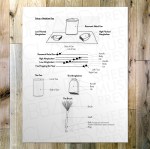
“SONIC EMBERS” is an ethereal multi-percussion solo that uses elements of improvisation and graphic score interpretation. Moose Davis asked that I compose an atmospheric piece as he had been working on pieces that were mostly fast + technically challenging at the time and wanted a stark contrast to those works.
Conceptually, “SONIC EMBERS” is based on images and text. The image (featured in the above album artwork for “SONIC EMBERS”) is a photo of the inside of a marimba resonator. This picture inspired me to write a text, which I then set to music as the score for “SONIC EMBERS.” While this piece is a setting of a text, the text is not recited during the piece. Each line of the text is realized as a line of the score and the text should guide the performer’s interpretation and performance.
While the score features no time signature, no tempo marking, and very few dynamic markings, “SONIC EMBERS” should be performed at a relatively slow tempo and quiet volume. Performers should feel free to stray from these tempo and dynamic suggestions should their interpretation of the score and text draw them to those conclusions. This piece is written spacially in the sense that events and silences should occur somewhat proportionally to how they are written in the score (each line of the score does not necessarily last the same amount of time).
“SONIC EMBERS” is great for students looking to explore multi-percussion works that feature graphic scores + improvisatory elements + ethereal soundscapes.
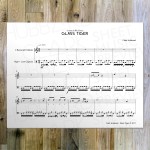
“GLASS TIGER” is a multi-percussion solo commissioned by Wes Fowler and was premiered by him on September 14th, 2018.
“GLASS TIGER” was initially composed with the idea that all of the instruments used in the setup could fit in a backpack/suitcase, so that “GLASS TIGER” would be an easy piece to travel with. Since the specific instrumentation is left up to the performer, setups can range in size from small (ex. woodblocks + desk bells) to large (ex. tom-toms and tuned gongs)!
The opening motif is played by the right hand, which is then joined by the left hand playing the same motif – offset rhythmically by a 16th note. The entire piece is structured around the performer playing ‘in phase’ with themselves and the rhythmic patterns moving around the setup to create melodic structures and patterns.
“GLASS TIGER” is great for students familiar with multi-percussion music and looking to explore minimalist and pattern-based music.






 Clark Hubbard | Music
You must be logged in to post a comment.