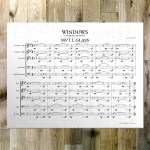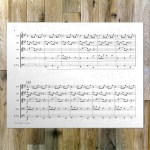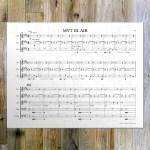
Windows

Duration: 14:51

Difficulty: ★★★☆☆

Released: 2017

Players: (5); 2 trumpets, french horn, trombone, bass trombone
Purchase PDF Sheet Music

About “Windows”

I. Glass [4:29]

II. Screen [5:03]

III. Air [5:19]

“Windows” is a brass quintet (2 trumpets, French horn, trombone, and bass trombone) made up of three movements (I. Glass, II. Screen, III. Air) based on three different types of windows/elements of windows. The entire work is about 15 minutes long. The inspiration of the piece stems from one of the marimba solos I was learning for graduate school at the time I composed this piece: “Reflections on the Nature of Water” by Jacob Druckman. Prior to learning the piece, my professor (Ji Hye Jung) told me to listen to another piece by Jacob Druckman called “Windows.” Upon hearing only the name “Windows” I instantly thought I knew what it would sound like. Druckman’s “Windows” sounds nothing like what imagined it would. So, the brass quintet I’ve written, “Windows,” is the piece that I expected Druckman’s piece to be prior to listening to that piece, or any other by Jacob Druckman.

I decided to write for bass trombone instead of tuba because I love the sound of the bass trombone.

I.GLASS

Imagine giant panes of glass floating in space. Perfectly clean panes against a completely black background. There is a small source of light coming from somewhere beyond the glass. The light reflects off of the panes of glass as they rotate in space, sometimes defining the edges of the panes, sometimes causing the panes to appear invisible. This is movement I. Massive panes of glass floating in and out of existence.

II.SCREEN

The canon ostinato in the two trumpets is a rhythmic interpretation of a screen over a window. The trombones and French horn act as insects zipping onto and around the window (particularly with the glissandi).

III.AIR

This movement is an open window on the most peaceful of days. The gentle breeze from the outdoors, the purest moments of nature.
Amager 16

Duration: 11:17

Difficulty: ★★★☆☆

Released: 2016

Players: (2) 2 Snare Drums

Purchase PDF Sheet Music

(written for the GreeneShark Duo)

About “Amager 16”

“AMAGER 16” is a snare drum duo in the style of a classical symphony with some contemporary elements. The work contains four movements that may be performed in succession or independently.

I. Sonata

The first movement follows classical sonata form with themes first presented in duple meter and later modulated to triple meter.

II. Slow

The second movement is framed by long buzz rolls and silent pauses. These textures are slowly overtaken by a quick, yet quiet, flurry of militaristic passages.

III. Waltz

The third movement is a waltz that involves both percussionists creating dynamic waves as their melodic phrases intersect.

IV. Finale

The fourth movement is a fast-paced recap of the previous movements while also introducing new material. One percussionist is called to perform rhythms by rapidly clicking their sticks together, but these passages may alternatively be played on the rim of the drum if the tempo proves to be too quick.

“AMAGER 16” is great for students who want to improve their snare drum technique while studying classical music forms. This is also an excellent piece for students to play alongside their instructor.

Percussion Quartet No. 1

Duration: 11:29

Difficulty: ★★★☆☆

Released: 2016

Players: (4) marimba (4.3 octave), vibraphone, xylophone, glockenspiel, 4 tenor drums, bass drum, hi-hat, 4 woodblocks

Purchase PDF Sheet Music

About “percussion Quartet No.1”

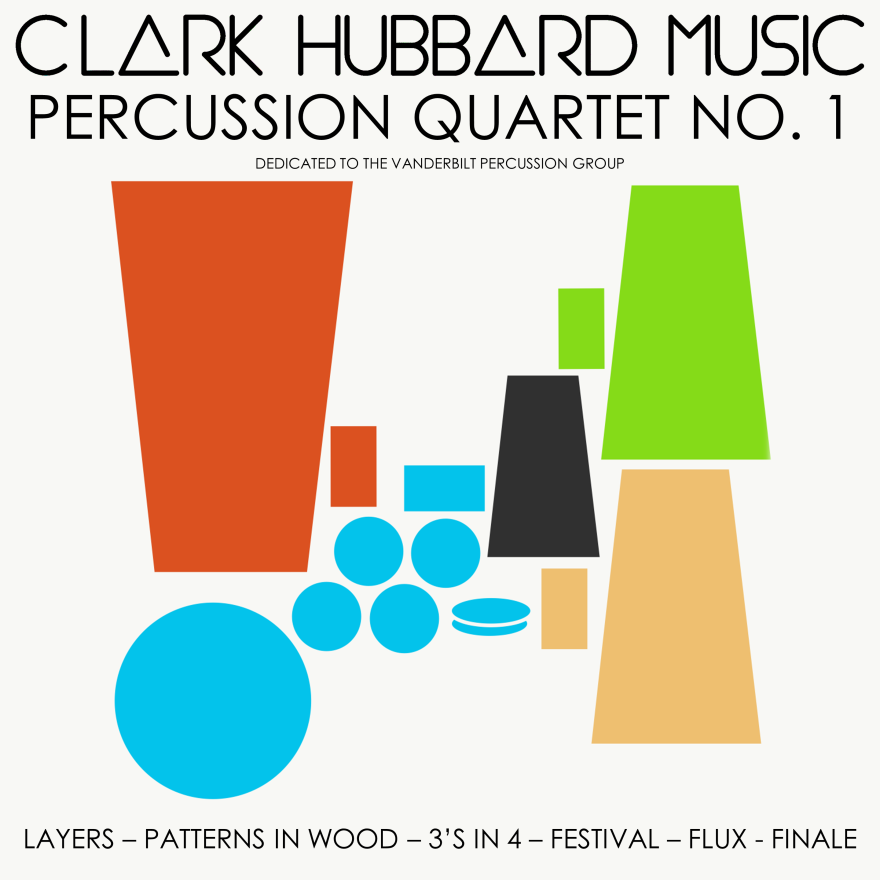
“PERCUSSION QUARTET NO. 1” is a percussion quartet that explores textures and melodic material throughout six different sections.

The piece opens with “Layers,” where instruments are slowly introduced into the growing, sonic environment. This is followed by “Patterns In Wood” where each player cycles between ‘A’ and ‘B’ patterns on woodblocks creating a variety of polyrhythmic textures. “Patterns” in Wood” then morphs into “3’s in 4” where players move through a chord progression in canon. A slight break may occur before the fourth section “Festival”: a brief, cheerful, and festive interlude. “Festival” quickly segues into “Flux” where each percussionist’s rhythmic material dissolves at different rates. “Flux” concludes with a desperate vibraphone solo above the sparse remains of the other instruments. “Finale” is a dramatic, fast-paced, and brief section that closes out the entire work.

Instrumentation
1 • 4 tenor drums, bass drum, hi-hat, woodblock, glockenspiel (shared w/ P4)
2 • marimba [4.3 octave], woodblock
3 • vibraphone, woodblock
4 • xylophone, woodblock, glockenspiel (shared w/ P1)

“PERCUSSION QUARTET NO. 1” is great for students looking for a quartet that will expose them to a wide variety of chamber music performance circumstances and environments.