“TWENTY” is a marimba solo inspired by the guitar music of Bruce Cockburn. Madeline Dethloff was a colleague and friend of mine in the Blair School of Music Percussion Studio at Vanderbilt University. She asked me to write a piece for her before I graduated, so I wrote this piece and gifted it to her on her twentieth birthday. Thematically, “TWENTY” should sound cheerful and celebratory.
Structurally, “TWENTY” is built around several different rhythmic ostinatos. The melody is plucked from these ostinatos as accented notes. The use of two-tone mallets may be helpful in distinguishing the melodic material from the ostinato texture.
“TWENTY” is great for students looking for a moderately challenging four-mallet marimba solo that blends contemporary percussion with pop music sensibilities in odd-meters.
Scintillation: the process of emitting flashes of light.
“SCINTILLATIONS” is a freeform mallet quartet in two parts which may be played in succession or independently. Suggested instrumentations are 4 marimbas or 2 vibraphones + 2 marimbas, although “SCINTILLATIONS” may be performed on any percussive (or non-percussive) instruments.
“SCINTILLATIONS” was premiered by the Vanderbilt Percussion Group at the Blair School of Music on April 4th, 2018. Clark Hubbard was asked to arrange the piece for non-melodic percussion instruments, and a drums-only version of this piece was premiered by the Eschaton New Music Ensemble on April 25th, 2018. Both (pitched + un-pitched) versions of “SCINTILLATIONS” are included in the score.
PART I This movement draws inspiration from Peter Garland’s mallet quartet “Apple Blossom.” “SCINTILLATIONS, PART I” is a lush chorale where the chords slowly dissolve into one another. The score is a diagram with the progression of notes indicated spacially [shown below]. The duration of this movement is indicated 6-15 minutes, although the length is ultimately left up to the ensemble.
Notes should be sustained (via rolls, bows, etc) throughout the movement and may also be sustained through the opening of “PART II.” “SCINTILLATIONS, PART 1” should begin at a pianissimo dynamic, but the performers should feel free to swell and grow as they see fit. The indicated pitches may be performed in any octave on the instrument, although treble and bass clef symbols are presented to suggest a general range.
PART II This movement is similar in spirit to “PART I,” but now includes a rhythmic variable. Each performer is presented with a series of cells/measures that include a set of pitches and a specified “number of attacks.” Each cell may be repeated an infinite number of times, but the entire ensemble should progress to the next cell in unison.
PART II • Rhythmic Notation Each cell should be approximately 3 seconds in length (alternatively, each cell can be interpreted as the duration of a single quarter note at 20bpm). Above each cell, a specific number of attacks are indicated. Performers may play the number of attacks per cell in any rhythm they desire (ex. if a cell indicates “3 Attacks”, the performer may play a triplet, two 16th notes followed by an eighth note, a dotted eighth note followed by two 32nd notes, etc). The cells may be repeated infinitely and each performer may have a slightly different interpretation of the length of each cell. The performers do not need to play each cell in rhythmic unison but should progress to the next cell at approximately the same time. PART II • Harmonic Notation Each cell indicates a single pitch or a series of pitches. Like “PART I,” these may be performed in any register, although a general guide of treble and bass clef is presented. Performers should map the rhythmic component of each cell onto any of the indicated pitches. Performers should avoid double stops, playing only one pitch per attack.
“SCINTILLATIONS” is great for students who want to explore percussion music with unconventional notation and for students looking for a piece that offers communicative + interpretive challenges rather than technical challenges.
*in the linked audio recording, “Part II” of “SCINTILLATIONS” was performed using an earlier edition of the score. In that edition, the rhythms were more rigid and defined. In the current edition, the rhythmic structures are dramatically more free and unpredictable.
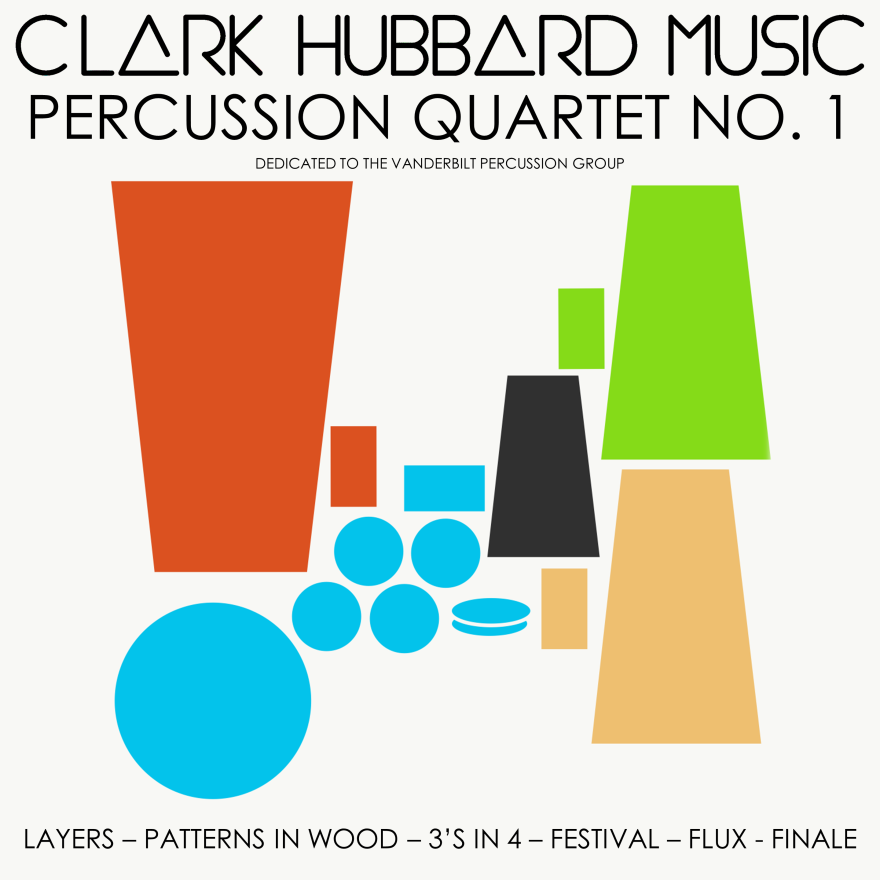
“PERCUSSION QUARTET NO. 1” is a percussion quartet that explores textures and melodic material throughout six different sections.
The piece opens with “Layers,” where instruments are slowly introduced into the growing, sonic environment. This is followed by “Patterns In Wood” where each player cycles between ‘A’ and ‘B’ patterns on woodblocks creating a variety of polyrhythmic textures. “Patterns” in Wood” then morphs into “3’s in 4” where players move through a chord progression in canon. A slight break may occur before the fourth section “Festival”: a brief, cheerful, and festive interlude. “Festival” quickly segues into “Flux” where each percussionist’s rhythmic material dissolves at different rates. “Flux” concludes with a desperate vibraphone solo above the sparse remains of the other instruments. “Finale” is a dramatic, fast-paced, and brief section that closes out the entire work.
“PERCUSSION QUARTET NO. 1” is great for students looking for a quartet that will expose them to a wide variety of chamber music performance circumstances and environments.





 Clark Hubbard | Music
You must be logged in to post a comment.